
Activity Tracker
A system monitor that logs which application and which window actually had focus, and separates real working time from idle time. It can block distracting apps and websites on a schedule, and reports where the day went.
I'm Sumant Mourya — an Android developer and automation engineer from India. I ship apps on the Play Store, and I build the spreadsheets, dashboards and scripts that quietly remove hours from someone's week.
Five apps. One is live, four are in active development — each with its own page explaining exactly what it does.
A full replacement for your phone's dialer — real two-way call recording, sleep schedules, blocking, auto-replies and a call screen you design yourself.
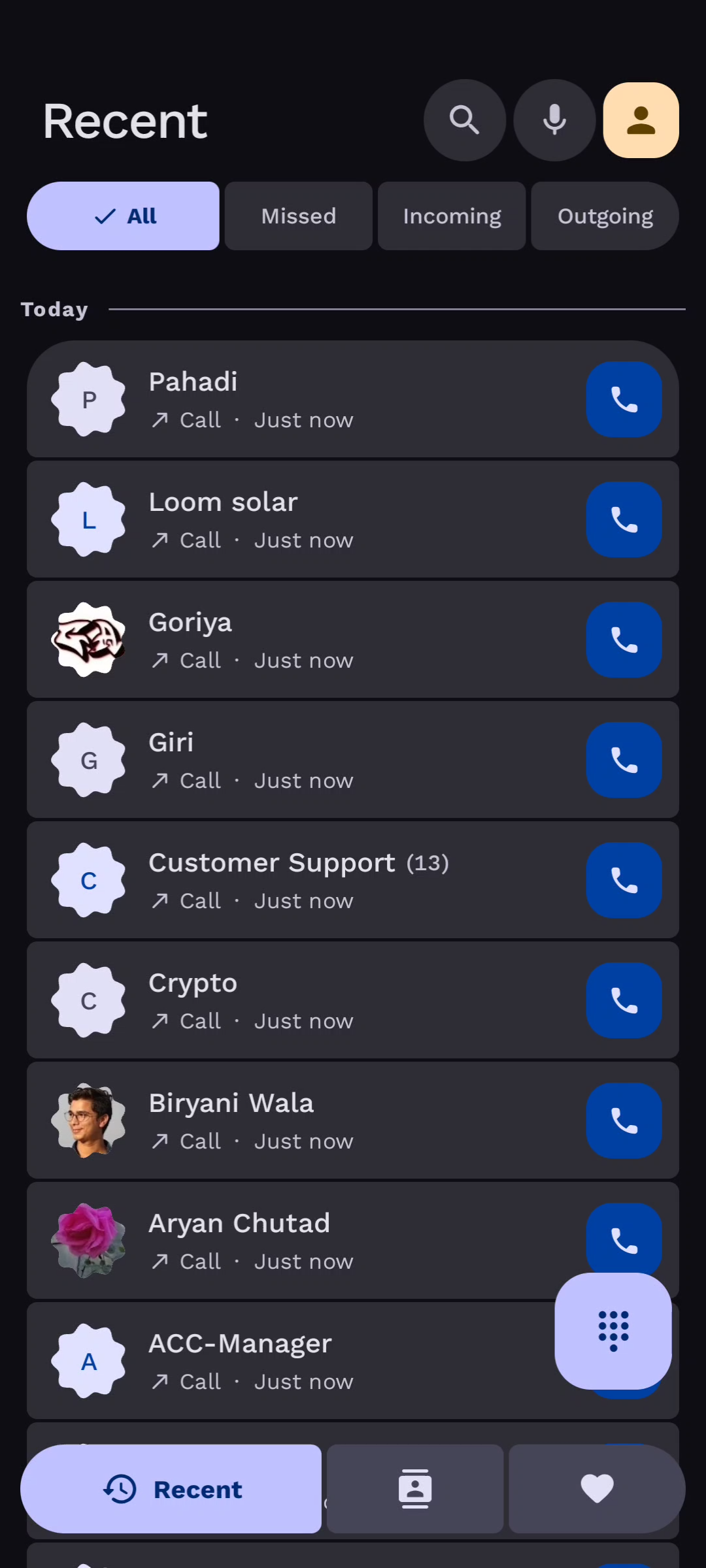
The companion that makes call recording possible. Runs a elevated capture server so the dialer itself needs no mic permission and no accessibility service.
The shop two streets away, on a live map. Real-time local deals, verified seller profiles and vendor onboarding that takes minutes.
Runs an entire gym from one phone — members, scannable entry passes, attendance, plans, payments, invoices and a leads pipeline. Works offline.
Ride together without losing each other. Everyone in the group appears on one live map, so you can navigate as a pack instead of pulling over to check where everybody went.
Each one was built to delete a specific repetitive job. Smaller than an app, and usually the thing that pays for itself in the first week.
A system monitor that logs which application and which window actually had focus, and separates real working time from idle time. It can block distracting apps and websites on a schedule, and reports where the day went.
Watches the inbox for new IndiaMART enquiries, parses the buyer's name, product and requirement out of the notification, and sends a tailored quotation reply within seconds — so a lead never waits for someone to open their email.
A batch pipeline that turns a spreadsheet row into a finished image — product creatives, social posts and store banners composed with custom fonts and layers, exported at every size a platform asks for.
Containerised jobs on RunPod for GPU work that a laptop can't finish: image and video generation queued through a serverless endpoint, results pulled back and filed automatically, with the pod shut down when the queue empties.
Takes a list of order or tracking numbers and checks each carrier for the current status and last scanned location, then writes the whole lot back to a sheet — so 'has it arrived, and where is it' is one run instead of an afternoon.
Generates print-ready shipping labels in bulk from an order sheet — address block, barcode, order id and courier details laid out to the right size, batched into one PDF for the label printer.
Builds numbered GST-style invoices from order data — line items, tax, totals and the customer block — exported as PDF and ready to send, with the numbering sequence kept consistent across runs.
A vision-driven bot that reads the game screen with template matching, decides on an action and executes it through ADB. Mostly an excuse to learn computer vision properly, and it worked.
Turns a sheet of text into finished social and store banners — custom fonts, layered composition and exact crops, generated in batches instead of nudged by hand in an image editor.
The unglamorous half of shipping an app: feature graphics, framed screenshots and icon exports generated at every size Google asks for, so a listing takes minutes rather than an afternoon.
A form-automation helper for the train booking rush — passenger details pre-filled and the timing handled, so you are not fighting a countdown and a keyboard at once.
Script in, ad out. Generates the scene footage, synthesises a voiceover and stitches the timeline into a finished promo clip ready to upload.
Eight areas I work in. If a person on your team repeats the same steps every week, that's a script waiting to be written.
Spreadsheets that behave like software. Custom functions, menus, triggers and scripts that pull, clean and push data on a schedule instead of by hand.
No-code apps on top of the data you already keep in Sheets — field forms, approvals and inventory a whole team can use from a phone.
Dashboards that answer the question rather than showing every number, modelled so the totals stay right when someone slices them.
The report that takes a whole morning, reduced to a button. Macros, dynamic formulas and templates built so the next person can still use them.
Repetitive SAP GUI work — extractions, uploads, reconciliations — driven by script instead of by keyboard, with logging so you can prove what ran.
Glue for everything that doesn't talk to everything else. File pipelines, scrapers, report generators, API clients and scheduled jobs.
Getting a computer to read a screen or an image — template matching, OCR pipelines, batch image processing and vision-driven automation.
Native Android in Kotlin and Jetpack Compose — from a single screen to a full app on the Play Store, including the listing and the policies.
Both are on the table. Pick whichever fits how well-defined the work is.
For work that will change shape as we go.
For work we can define up front.
A screen recording or a sample file beats a description. I need to see the actual clicks to know what can be removed.
I come back with what I'd automate, what I'd leave manual and why — then an hourly estimate or a fixed price, whichever you prefer.
Anonymised if it's sensitive. Building against a sanitised sample is how automations break in week two.
Commented code, a short written guide and a walkthrough. You should be able to hand it to someone else without calling me.

One half is Android. I write Kotlin and Jetpack Compose, and I care about the parts most apps skip — what happens offline, which permissions are genuinely needed, and whether your data ever has to leave the device.
The other half is automation. Google Sheets and Apps Script, AppSheet, Power BI, advanced Excel and VBA, SAP GUI scripting, Python, OpenCV and GPU pipelines on RunPod. Different tools, same instinct: if a person is doing it the same way every week, it should be a script.
Both halves feed each other. GymDesk exists because a gym was running on a paper register; Recline exists because a dialer wanted a subscription for a feature that should be free.
An app, a dashboard, a script that kills a weekly chore — or a bug in one of my apps. Same inbox handles all of it, hourly or fixed-price.
SumantKushwaha.dev@gmail.com